


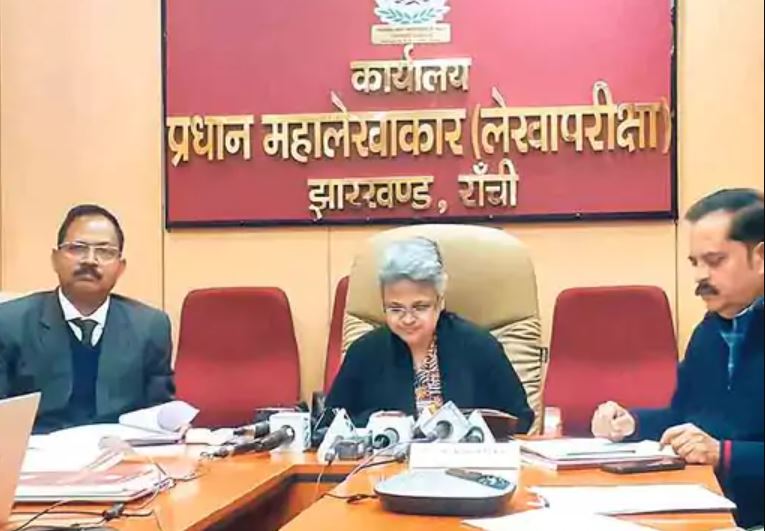
Jharkhand’s minor mineral management came under sharp scrutiny after the Comptroller and Auditor General (CAG) presented a performance audit in the Assembly, revealing widespread procedural gaps, delayed auctions, faulty lease approvals and significant revenue loss. The audit, conducted between November 2022 and October 2023, showed that 85% of trips by mineral-carrying vehicles were made without valid challans and that none of the 72449 registered vehicles were equipped with GPS or RFID systems mandated under state rules.
Also Read: Jharkhand Cabinet Cleared Higher Cess Rates on Mineral-Bearing Land, Notification Issued
Irregular Transport and Monitoring Failures
According to Principal Accountant General Indu Agrawal, weighbridge samples showed that only 720 out of 4,949 trips matched the registered vehicle numbers on the JIMMS portal, while 2615 weighbridge entries contained no vehicle number at all. The State relied solely on manual permits and challans to detect unauthorised movement, resulted unchecked overloading, illegal transport and misuse of e-challans. Audit teams also noted cases where additional challans were issued even before the validity period of earlier ones had expired, raising concerns about manipulation. The report added that in seven districts surveyed, beneficiaries expressed worries about environmental degradation and loss of farmland due to unregulated mining activity, while only 29% acknowledged any benefit in terms of local employment.
Also Read: Audit Report Tabled in Jharkhand Assembly Exposed Lapses in Financial Management
Faulty Leases, Forest Land Violations and Revenue Loss
The CAG found that mining leases were issued without proper verification of land classification, ownership or mandatory documents. In Sahibganj, the then Deputy Commissioner approved leases over 4.74 hectares, well beyond the permissible limit and did so without e-auction. In Chatra and Palamu, eight leases were issued on plots classified as forest land, in violation of the Forest Conservation Act, 1980. Under-reporting of stone extraction led to substantial financial loss. BIT Sindri’s assessment confirmed that 93.53 lakh cubic metres of stone output was not reported, resulting in an estimated impact of 292.75 crore. In 26 leases across four districts, miners exceeded permissible extraction limits by 33.21 lakh cubic metres, but penalties of 205.21 crore were never imposed. Mining plan compliance also remained poor. Of the 74 leases scrutinised, 64 were approved without essential documents, and in several cases mining plans were submitted and cleared on the same day. Boundary pillars were missing, and no effective supervision mechanism existed to prevent encroachment into safety zones.
Also Read: Rs. 92 Crores will be Recovered from Two Companies for Illegal Mining in Jharkhand
Slow Auctions and Sand Ghat Mismanagement
Auctioning of minor mineral blocks remained sluggish, with only 11 of 292 available blocks auctioned between 2018 and 2023, just 3.77% of the total. Royalty revenue fell sharply from 1082.44 crore in 2017-18 to 69773 crore in 2021-22. Sand Ghat administration emerged as another area of major concern. JSMDC Limited initiated operations in only 21 of the 389 Ghats assigned to it, while 368 Ghats spread across 9782 acres remained closed for years. This alone caused a potential loss of 70.92 crore. District Survey Reports showed inconsistencies in sand availability, and several Ghats in Pakur, Dhanbad and Simdega registered no mining activity at all. The audit also found discrepancies in ownership records, gaps in re-survey, and inadequate IT systems for monitoring sand movement. Despite policy provisions, GPS-enabled vehicles, CCTV surveillance and automated stock monitoring were never implemented.
Also Read: Palamu Became Key Corridor for Illegal Coal Transport to Bihar and UP from Magadh Colliery
Environmental Compliance Remained Weak
Environmental safeguards and restoration commitments were largely ignored. Of 63 leases requiring plantation and reclamation work, only 2225 trees were planted against the mandated 74676. Twelve leaseholders had not submitted mine closure plans even after their lease periods ended. Excess extraction of 6.35 lakh cubic metres of stone between 2022 and 2024, valued at 19.68 crore, was also flagged as unauthorised mining. The CAG recommended a centralised online application and verification system for lease approval, stronger tracking of vehicle movement through GPS integration with the JIMMS portal, and stricter enforcement of environmental conditions to prevent further revenue and ecological loss.
Also Read: Jharkhand Moved to Recover Dues from Panem Coal for Illegal Mining
Join the WhatsApp Group of Business Jharkhand to Stay tuned for all the latest updates of industrial-political developments in Jharkhand.
